
Inside the 2026 NDAA
Batteries, Solar, Minerals, and the DFC
Welcome to Charged States, a publication focused on the geopolitics of the energy transition. The goal is to help explain politics to the energy world, energy to the political world, and a little bit of both to everyone else.
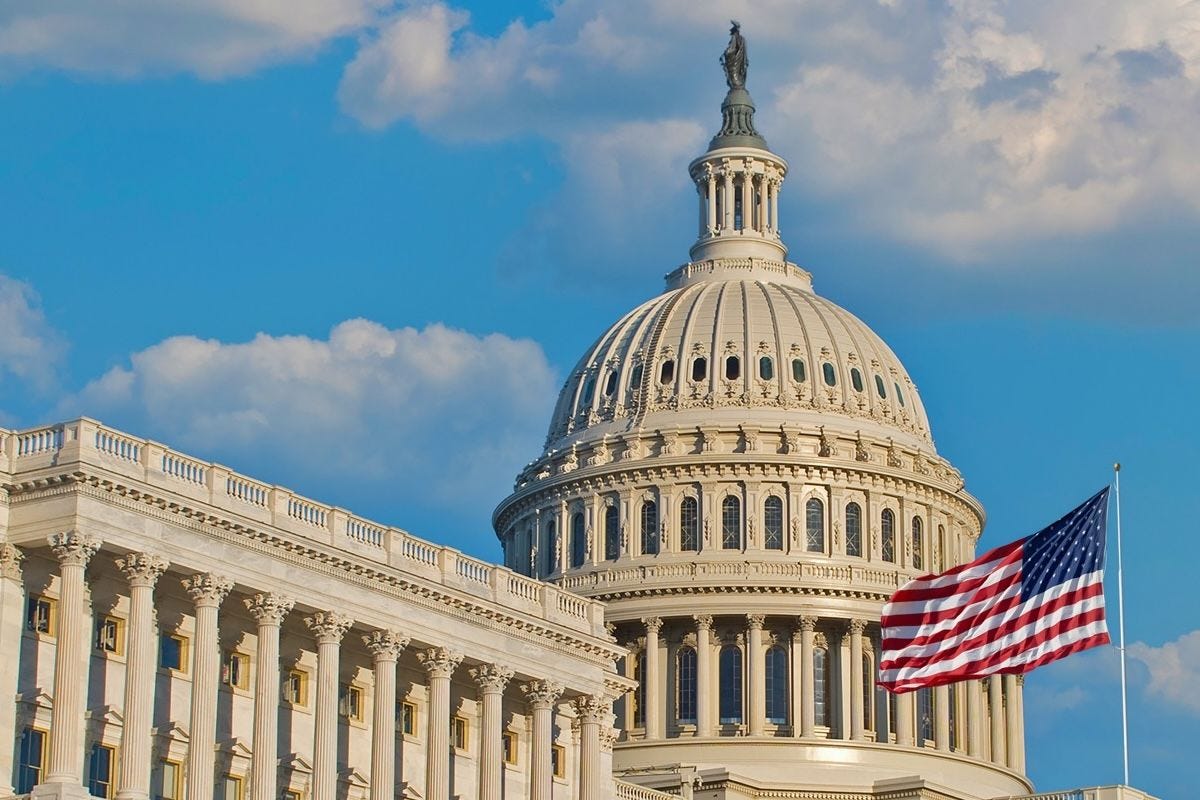
The House of Representatives approved the Fiscal Year 2026 NDAA last night and the bill now goes to the Senate for approval. The $900.6 billion authorization bill passed by a 312-112 vote. The NDAA includes several sections related to critical minerals, battery components, and energy technologies. Below is a rundown of what is in the NDAA pertaining to these topics and the key takeaways so you do not have to read all 3,000-plus pages.
What is the NDAA?
The National Defense Authorization Act (NDAA) is the annual legislation that authorizes funding levels, policies, and organizational changes for the U.S. Department of Defense (DoD).1
Below is an overview from the Congressional Research Service:
The NDAA establishes or continues defense programs, policies, projects, or activities at the Department of Defense and other federal agencies, and provides guidance on how the appropriated funds are to be used in carrying out those authorized activities.
Overall, it sets strategic priorities for the military, governs everything from personnel and procurement to emerging technologies and industrial base security, and serves as Congress’s primary tool for shaping defense policy. The NDAA touches everything the military does - from healthcare to training to organization to munitions to critical minerals. You name it, it is in the bill. And because it is considered “must-pass” legislation, the NDAA often becomes the vehicle for major bipartisan policy initiatives. This year Congress also reauthorized the DFC through the NDAA rather than through a standalone bill.
The bill should be approved by the Senate and signed into law by the President by the end of the year.
Key Sections of the NDAA Related to Critical Minerals or Energy Technologies
SEC. 842 — Prohibition on Acquisition of Advanced Batteries from Certain Foreign Sources.
Section 842 requires the DoD to phase out all advanced batteries containing Chinese or other “foreign entity of concern” materials, components, or technology. New acquisition programs must comply by 2028 and all existing systems must comply by 2031, with only narrow exceptions. This is effectively a mandate to build a fully non-Chinese battery supply chain for U.S. defense applications.
The restrictions are for both purchased batteries, and batteries “embedded within warfighting and support systems.” And the restrictions are extensive - they cover cathode materials, anode materials, separators, anode foils, solvents, additives, electrolyte salts, and internal safety devices. We are not just talking about the cell or battery pack.
The battery can include limited Chinese material only if the battery was assembled in a non-FEOC country2, “95 percent of the costs” comes from non-FEOC sources, and it is produced without technology licensed from a FEOC.
SEC. 844 — Prohibition on Procurement of Molybdenum, Gallium, or Germanium From Non-Allied Foreign Nations and Authorization for Production From Recovered Material.
This expands the DoD’s ban on procuring materials from non-allied foreign nations by adding molybdenum, gallium, and germanium to the prohibited list. All three critical minerals have faced Chinese export restrictions, and their production is dominated by China. Gallium and germanium have faced severe restrictions, but they are vital for semiconductors and advanced defense applications.
The section also states these materials can now be sourced from recycled inputs if the original source was non-adversarial and all reprocessing occurs in the U.S. or allied countries.
The prohibition for gallium and germanium will phase in over two years. For gallium, this timing should line up with scheduled production from the Alcoa-Sojitz facility in Australia the DoD is supporting with Japan and Australia. The procurement regulation is a good way to backstop the project by ensuring offtake for the project.
SEC. 847 — Prohibiting the Purchase of Photovoltaic Modules or Inverters From Foreign Entities of Concern.
Section 847 prohibits DoD from purchasing solar cells, modules, or inverters made by Chinese and other “foreign entities of concern” using FY2026 funds. The prohibition only relates to direct DoD procurement.
Chinese companies dominate the entire solar supply chain but FEOC-made inverters have been repeatedly flagged by DOE, DHS, and FERC analysts as potential cyber risks. Solar inverters contain communication modules, firmware, and grid-interface systems but 9 out of 10 largest global PV inverter companies are Chinese.
SEC. 848 — Clarification of Procurement Prohibition Related to Acquisition of Materials Mined, Refined, and Separated in Certain Countries
Section 848 clarifies and strengthens an existing prohibition by making it explicit that DoD cannot procure any covered critical material if it was mined, refined, or separated in a “covered nation” like China or Russia. This closes loopholes and ensures DoD avoids adversarial supply chains at all stages of material production.
DFC Modernization and Reauthorization Act of 2025
One of the biggest wins of the NDAA is the reauthorization of the International Development Finance Corporation (DFC). DFC’s authorization expired in October, but the NDAA reauthorizes the development finance institution until December 31, 2031.
Key provisions in the reauthorization that are important for critical minerals and the DFC broadly.
DFC’s maximum contingent liability (DFC’s credit card limit) has increased from $60 billion to $205 billion.
The bill establishes a new $5 billion Equity Investment Account to increase the use of equity investments in key projects, and it raises the allowable equity share per project from 30% to 40%.
The DFC remains focused on developing countries; however they can now support projects in “wealthy countries” if the project pertains to “energy”, “critical minerals and rare earths” or “information and communications technology, including undersea cables.”
However, DFC support must be less than 25% of project’s total cost and all high-income projects together must be less than 10% of DFC’s total exposure.
Congress specifically states that critical minerals supply chains should be a top priority for the DFC over the next few years.
One other interesting note - there were reports earlier this year the Trump Administration was looking to use the DFC to support domestic projects. Congress expresses its view on this matter in the reauthorization. It is the “Sense of Congress” that DFC funding “should not be diverted for domestic or other activities.”
Main Takeaways
When discussing defense demand for batteries or critical minerals, the common refrain has been that defense-related demand is not big enough to drive markets or make projects economical. This remains true. However, the argument has often served as a justification for inaction. This will not solve our broader issues but the US and allies need every tool and demand driver possible to build new supply chains. The NDAA increases the power of the limited demand into a catalytic force by embedding clear, legally binding demand signals into procurement policy.
We should expect to see price bifurcation. Companies that can demonstrate a full non-Chinese supply chain will be able to charge more for their products and the defense market will be willing to pay for it.
Congress can create these rules because the defense sector does not have the same financial constraints as the commercial sector. The DoD budget is practically unlimited in the U.S. If there is a national security risk from Chinese-dominated supply chains through either trade restrictions (critical minerals) or cyberattack (inverters) then Congress will authorize the money. And we learned over the last year the cost of inaction can be more expensive than the cost of action. (I’m being hyperbolic and Pentagon folks will disagree but coming from the State Dept which had no budget…The size of the NDAA was $8 billion larger than what the DoD asked for.)
The commercial sector cannot operate this way. Companies must maintain strong margins to support operations, satisfy shareholders, and remain competitive.
Congress and the Administration should look to see how they can institutionalize these requirements at the international partner level. We are in the midst of a military buildup, how can the U.S., Europe, and Pacific allies take advantage of it to build new supply chains? While DoD demand will not build a battery factory, joint NATO or NATO-IPP procurement rules could build stronger demand. (Understanding the challenges the Administration is creating for our international partnerships)
Despite the importance of the new rules, the reauthorization of the DFC is the most important critical minerals related part of the NDAA. The higher liability limit, increased equity participation, and ability to fund minerals projects in more countries is vital for global engagement and building new supply chains. The higher liability cap is especially important given the capital-intensive nature of mining projects.
The less rosy view
If robust commercial demand already existed, Congress would not need to mandate these requirements, nor would the DoD be forced to scramble to stand up a non-Chinese supply chain. If the United States had a strong battery and EV supply chain (AND did not eliminate the policies helping to build one) the DoD would be able to piggyback off the commercial demand. The DoD can support the development of part of the supply chain, but the USG will be forced to procure the technology at a premium.
The Trump Administration is using the Pentagon to drive demand across the industrial base, but it would be more efficient, the economy would do better overall, and we would be more globally competitive, if we had a growing commercial sector for these technologies. We are once again trying to catch up for our own policy mistakes.
The big question - When it comes to the battery rules, is this even possible?
Right now, meeting the battery requirements is likely not possible. I do not believe any producer would be able to meet the requirement that 95 percent of a battery’s total costs originate from non-FEOC sources. Will it happen by 2028, when the first requirements kick in? I don’t know. The NDAA does allow for a waiver process if the requirements cannot be met. It will be very interesting to see if a waiver is needed come 2028.
No, I am not calling it the DoW
FEOC = Foreign Entity of Concern. When it comes to critical minerals and battery tech it is almost always China but the list also includes Russia, North Korea, and North Korea.